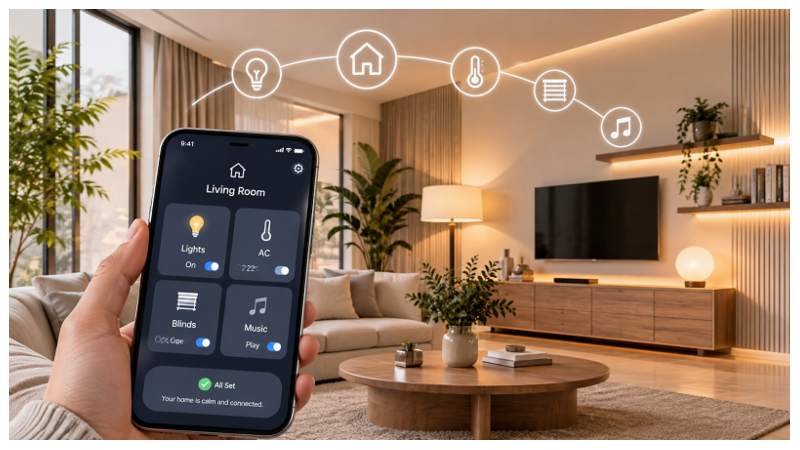
Connected lighting, blinds, heating and sensors can make a house quieter, warmer and better lit. They can also leave a client holding a phone with five apps on it, none of which talk to each other, wondering why the hallway lamp needs a software update. The difference is almost entirely down to decisions made at the specification stage rather than at installation.
1. Coordination Is the Design Problem, Not the Technology
Individually, every connected product on the market works. The failure happens at the seams: a lighting brand that uses one wireless standard, a blind motor that uses another, a thermostat tied to its own cloud service, and a sensor that only reports into an app nobody opens.
For an interior designer, this is a familiar type of problem. It is the same discipline as specifying ironmongery, where consistency of finish and operation across a house matters more than any individual handle. The connected layer needs a house style too, and it needs to be set before anything is ordered.
The practical rule is to choose the control layer first, then choose only products that speak to it. Reversing that order is what produces the five-app house.
2. Choosing a Control Layer
There are broadly three approaches, and they suit very different projects.
| Approach | How it works | Suits | Watch for |
| Single ecosystem | All devices chosen from one brand family | Small flats, simple refurbishments | Limited choice of finishes and styles |
| Open standard hub | Devices from many brands joined by a common protocol | Most residential projects | Requires a properly placed hub and network |
| Wired control system | Dedicated cabling and control processors | New builds and full renovations | Must be specified before first fix |
For a typical UK refurbishment, the middle option usually wins. It allows a designer to choose switch plates and luminaires on aesthetic grounds while keeping everything answerable to one interface, which is the outcome clients actually want.
3. Lighting: Get the Layers Right Before Worrying About Protocols
No amount of connectivity rescues a badly lit room. The lighting design comes first: ambient, task, accent and decorative, with separate circuits for each layer so they can be balanced against one another.
Only once those layers exist does dimming and scene control become useful. A living room with one pendant on a smart bulb has a novelty. The same room with a wash of ambient light, a reading lamp, picture lighting and a table lamp, all grouped into three scenes, has a design.
Points worth settling early:
- Dim at the driver, not the bulb, wherever possible. Mixing smart bulbs with a dimmer switch is a common source of flicker and buzz.
- Colour temperature consistency. Specify one temperature per room across all fittings. Mixed temperatures read as a mistake even when everything is dimmable.
- Switch plates still matter. A house with no physical switches frustrates guests, cleaners and anyone whose phone is upstairs.
- Neutral wire availability. Many older British properties lack a neutral at the switch, which rules out some smart switch ranges entirely.
4. Blinds and Window Treatments in Older Housing Stock
Motorised blinds and curtains are the single upgrade most clients notice daily, and they are also where period properties cause the most trouble. Sash windows, deep reveals, plaster cornices and non-square openings all complicate a straightforward motorised track.
Battery-powered roller mechanisms have made retrofit far easier, and they suit rooms where chasing in a power supply would mean destroying original plasterwork. The compromise is recharging, which clients tolerate for a bedroom and resent for a double-height stairwell window. Anywhere that is awkward to reach deserves a hard-wired motor even if the rest of the house is battery driven.
Fabric selection interacts with the mechanism. A heavy interlined curtain needs a track and motor rated for the weight, and a blackout roller in a wide bay needs either a wider tube or a split into two blinds to avoid deflection.
5. Climate Control and the Sensors That Earn Their Place
Zoned heating is where connected systems repay their cost, particularly in the kind of Victorian and Edwardian stock common across Britain, where one room is always cold and another is always stifling. Smart thermostatic radiator valves allow room-by-room scheduling without replacing a boiler or lifting floors.
The limits are worth understanding. A valve controls a radiator, not a room, so a room with poor insulation or significant draughts will still struggle. Sensors reporting genuine room temperature rather than radiator temperature make the schedule far more accurate, and placing them away from radiators and sunlit walls matters more than the brand on them.
Humidity deserves attention alongside temperature in older properties. A cheap humidity sensor in a bathroom or a north-facing bedroom, linked to extraction, does more for a client’s comfort and for the building fabric than another lighting scene.
Sensors deserve the same scrutiny, because they are the part of a connected home that most often ends up unused, because too many are installed doing nothing useful. The ones that consistently justify themselves are motion sensors on circulation routes for low-level night lighting, contact sensors on external doors, leak sensors under sinks and behind washing machines, and temperature and humidity sensors in problem rooms.
Everything else should be judged against a single question: does it trigger an action a household actually wants, without needing anyone to look at an app?
6. Where the Hardware Behind These Ranges Comes From
Interior designers usually meet this category through distributors and specification agents, which hides how the products are made. A large share of connected lighting drivers, blind motors, sensors and control panels are produced by a relatively concentrated set of manufacturers, then finished and branded for different markets.
That is why a b2b exhibition sits behind so much of what eventually appears in UK showrooms. Sourcing platforms connect buyers and specifiers to verified suppliers and to OEM and ODM manufacturers, which is how smaller British lighting and blind brands produce hardware to their own specification and finish without operating a factory.
For a design studio, understanding this makes specification conversations more productive. Asking a supplier about the underlying module, its protocol support and its firmware update policy gets more useful answers than asking about the badge on the front.
7. Seeing the Category Before It Reaches British Showrooms
Product categories tend to appear at sourcing exhibitions a year or more before they settle into UK distribution, which makes those events a useful read on where connected interiors are heading. The Global Sources Hong Kong Shows take place at AsiaWorld-Expo in two phases, 11 to 14 October and 18 to 21 October 2026, with smart home, security and appliance products in the second phase.
A specifier walking the smart home expo halls can see how quickly interoperability is improving across categories. The second phase alone brings together more than 2,100 suppliers and over 4,000 booths, including more than 1,200 AI-themed booths across seven segments, which gives a fair picture of which connected features are becoming standard and which remain marketing.
8. Specification Notes Worth Writing Down
A connected interior stays calm when four things are true. The control layer is chosen first. Every product is checked against it before ordering. Physical controls remain on the wall for anything used daily. And the scheme is designed so that if the internet fails, the lights still work from a switch.
Clients rarely ask for any of that, but it is what they mean when they say they want a house that feels simple.