The stone bath turns up on a pallet. Four of us, a narrow Georgian staircase, a fair amount of language, and then somebody asks the question that should have been asked back in March. Will the floor actually take it?
We have that conversation more than we’d like. Many of the houses people want to spend proper money on in Exeter are 150 to 200 years old, with joists that plumbers have been notching since the 1950s and a top-floor tap that coughs before it runs. None of that rules out a beautiful bathroom. It just changes the order you do things in. Here’s what we look at in an older house before anyone picks a tile, and what the good stuff realistically costs in 2026.
What Actually Makes a Bathroom High End
Not the taps. Well, not only the taps. We’ve seen £1,200 brassware fitted over a floor that bounced every time someone walked past the basin, and within a year the grout lines had cracked right across the room.
When people ask what separates a genuine high end bathroom in Exeter from a nice room with expensive fittings, our answer is nearly always the stuff behind the walls and under the floor. Here’s how we think about the features clients ask for most:
- Walk-in showers and wet rooms. Completely dependent on tanking (a waterproof membrane system applied to walls and floor before tiling).
- Underfloor heating. Electric mats are simple in a small room. Wet systems running off the boiler are cheaper to run but need more floor depth, which older houses rarely have spare.
- Large-format porcelain. Slabs of 1200 x 600mm or bigger look superb, but they need a dead flat, stiff floor. A big tile won’t flex with timber the way a small one forgives it.
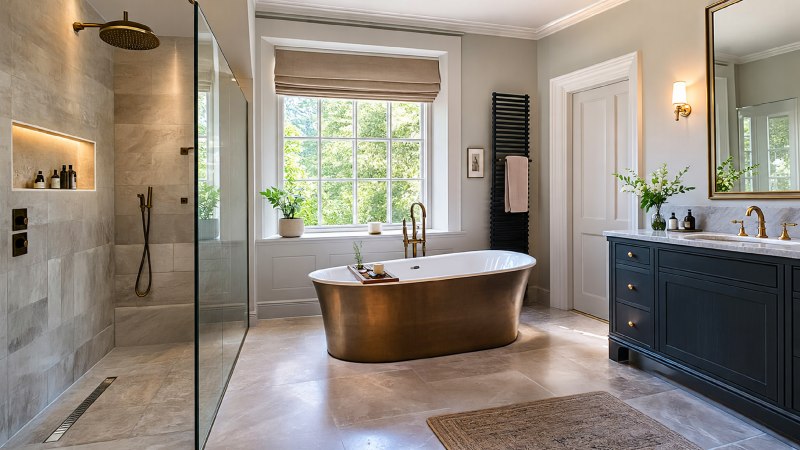
- Freestanding baths. Stone resin, cast iron, copper or solid stone. The weight matters more than the price tag.
- Concealed thermostatic valves. The controls sit flush, with all the pipework hidden in the wall. Clean looking, but plan how you’ll reach the cartridge in ten years.
Honestly, if the budget is tight, we’d rather spend it on a stiff floor and proper waterproofing than on a showier bath. Nobody admires a bath that’s sitting on a damp ceiling.
Start With the Floor: Joists and Heavy Baths
A typical Victorian or Georgian upper floor has softwood joists around 175 to 200mm deep, often at 400mm centres or wider. Every heating system and rewire since has cut another notch in them. We regularly lift boards in Heavitree terraces and find a joist that is more hole than timber.
A stone resin bath might weigh 100 to 150kg empty. A cast iron roll top is often 150 to 200kg. A solid carved stone or marble bath can be 400kg to well over a tonne. Then add 250 to 350 litres of water, which is roughly the same in kilos, and a person in it. That’s easily half a tonne on a footprint smaller than a single bed.
For anything heavier than a standard acrylic or steel bath, we’d want a structural engineer to look at it. That usually costs £300 to £700 for a site visit and calculations. Doubling up joists or spreading the load across several of them usually adds £600 to £2,000 to the job, which is a lot less than replacing a collapsed kitchen ceiling.
For large-format tiles on timber, we’d normally overboard with 18mm ply or tile backer board plus a decoupling membrane. It raises the floor by 20 to 30mm, so think about the door threshold early.
Water Pressure in a House Built for Jugs
A big rainfall head is only as good as the water feeding it. Lots of older houses still run on a gravity system, with a loft tank giving roughly 0.1 bar per metre of drop. On the floor just below it, that’s barely a trickle.
Up the hill in Pennsylvania, the mains pressure can be noticeably lower than down by the river, and some streets are still on old 15mm or even lead supply pipes from the road. A decent rainfall shower wants something like 12 to 15 litres a minute.
The usual fixes, in order of how much we like them:
- Unvented hot water cylinder. Mains pressure hot water, but it needs a good incoming flow, ideally 20 litres a minute or more. Typically £2,000 to £3,500 fitted.
- Upgrading the supply pipe. Swapping an old lead or 15mm supply for 25mm plastic pipe from the boundary. Usually £1,000 to £3,000, depending on the length and whether a front path needs lifting.
- Shower pump. Fine on a gravity system, around £400 to £900 fitted. Noisy if fitted badly, and not allowed on a direct mains connection.
Try this before you fall for a shower: time a 10 litre bucket filling from the cold kitchen tap, everything else off. Under 40 seconds is promising. Over a minute and you’ll need to spend money on the supply first.
Wet Rooms on Timber Floors
A level-access wet room is what most clients ask about first, and in an old house it’s very doable. You just need room under the floor for the fall.
The floor has to slope towards the drain, typically by around 1 in 80 to 1 in 100 across the showering area. On timber, that means lowering a section of floor and fitting a pre-formed tray former. You can’t just cut the joists down to make space, so sometimes they need trimming and supporting instead. A linear drain along the wall makes the fall easier and looks tidier with big tiles.
Then the tanking. Every joint and pipe penetration gets sealed, and the membrane goes up the walls to at least shower height. It’s dull work you’ll never see again, which is exactly why it’s the last place to save money.
Don’t forget ventilation. Building regulations call for an extractor that can shift 15 litres a second in a bathroom. A steamy wet room in an old house needs every bit of that.
Period Houses, Conservation Areas and Listed Buildings
St Leonards has handsome Georgian and Regency terraces, with tall ceilings and small back rooms never meant to hold a bath. Pennsylvania mixes Regency villas with Victorian terraces on steep plots. Heavitree is mostly Victorian and Edwardian terraces, where the bathroom usually sits in the back addition over the kitchen. Down in Topsham you’ll find older merchants’ houses and cottages whose floors have settled for centuries and won’t be fixed with a bag of self-leveller.
If the house is listed, you’ll almost certainly need listed building consent for internal changes such as cutting into historic floors or moving walls. Talk to Exeter City Council before anything is ordered. Plenty of St Leonards and Topsham streets also sit in conservation areas, which mainly affects visible outside changes like a new vent on the front.
Our advice? Keep the bones of the room where you can. Original sashes and cornicing make a period bathroom feel special in a way no amount of porcelain will.
What a High End Bathroom Costs in 2026
Rough figures for a full refit of a medium bathroom in an older house, fitted, before VAT where the fitter is registered:
- Full high-end refit (strip out, plumbing, electrics, tanking, tiling, fittings): £18,000 to £35,000, and more for large rooms or stone throughout
- Wet room conversion on a timber floor: £9,000 to £16,000 for the room
- Electric underfloor heating, supplied and fitted: £500 to £1,200 for a typical bathroom
- Large-format porcelain, supplied and laid: £90 to £180 per m², including boarding and membrane
- Freestanding bath: £1,200 to £4,000 for stone resin or cast iron, £5,000 to £15,000 for solid stone
- Concealed thermostatic shower with rainfall head: £800 to £2,500 for the kit, plus first-fix labour
- Floor strengthening: £600 to £2,000, plus £300 to £700 for an engineer
Labour is usually 35 to 50% of the total on a job like this. Allow three to five weeks on site.
Choosing Who Does It
Ask to see public liability insurance, and check whoever does the electrics is registered to sign off Part P work. Anyone touching a gas boiler must be Gas Safe registered. Get the quote in writing, with tanking and floor preparation as separate lines rather than lumped into “labour”. A deposit of 20 to 30% is normal. Much more, ask why.
If you’re planning a period bathroom refit and want an honest opinion on what your house can take, have a chat with Luxury Bathrooms Exeter before you order the bath.
Frequently Asked Questions
How much does a high end bathroom cost in Exeter in 2026?
For a full refit of a medium room in an older house, expect roughly £18,000 to £35,000. Solid stone baths and structural work push it higher.
Can my Victorian floor take a stone bath?
Possibly, but get it checked first. A solid stone bath can weigh 400kg or more empty, before 250 to 350 litres of water. An engineer’s visit is around £300 to £700, and strengthening usually adds £600 to £2,000.
Why is the water pressure so poor in my top-floor bathroom?
Gravity tanks in the loft give very little pressure on the floor just below, and old lead or 15mm supply pipes make it worse. An unvented cylinder (£2,000 to £3,500) or a new supply pipe (£1,000 to £3,000) usually sorts it.
Do I need permission for a new bathroom in a listed Exeter house?
Usually yes, if the work touches historic fabric. Cutting into original floors or moving walls in a listed building generally needs listed building consent, so speak to the council first.
Is a wet room possible on an upstairs timber floor?
Yes, in most cases. The floor is lowered to create a fall to the drain, then fully tanked. Expect £9,000 to £16,000 for a full wet room conversion, depending on size and finishes.